Models
Scientific Singularity?
A couple of weeks ago Kevin and I went around on the topic of whether or not science is “broken”. We came to the point of agreeing that we have different basic assumptions of what constitutes “utility”. And because of this, while we could agree that each of our arguments made sense logically, we ultimately end up with opposite conclusions. After all, for something to be broken it means that it once served a purpose that it no longer is able to serve due to mechanical/structural failure. And to have a purpose means that it has value (i.e. utility) to someone.
So whether science is broken or still works depends your definition of utility. Kevin and I agreed on a measurement for scientific utility, based on (a) how well it explains observed phenomena, (b) how well it predicts new phenomena, and (c) how directly it leads to creation of technologies that improve human lives. We can call it “explanatory power” or EP for short. …
A New Cancer Mentality
This interview was done as part of the New Cancer Mentality initiative:
New Cancer Mentality is a grassroots organization focused on giving cancer patients a virual townhall to ask their questions to leading oncologists and researchers about their work. Furthermore, New Cancer Mentality focuses on bringing about collaboration between researchers as well as giving researchers an online forum to share their views and what needs to be done to cure this disease.
If you’d like to learn more or join the movement, check out blog and contact David.…
Epidemiology vs. Etiology
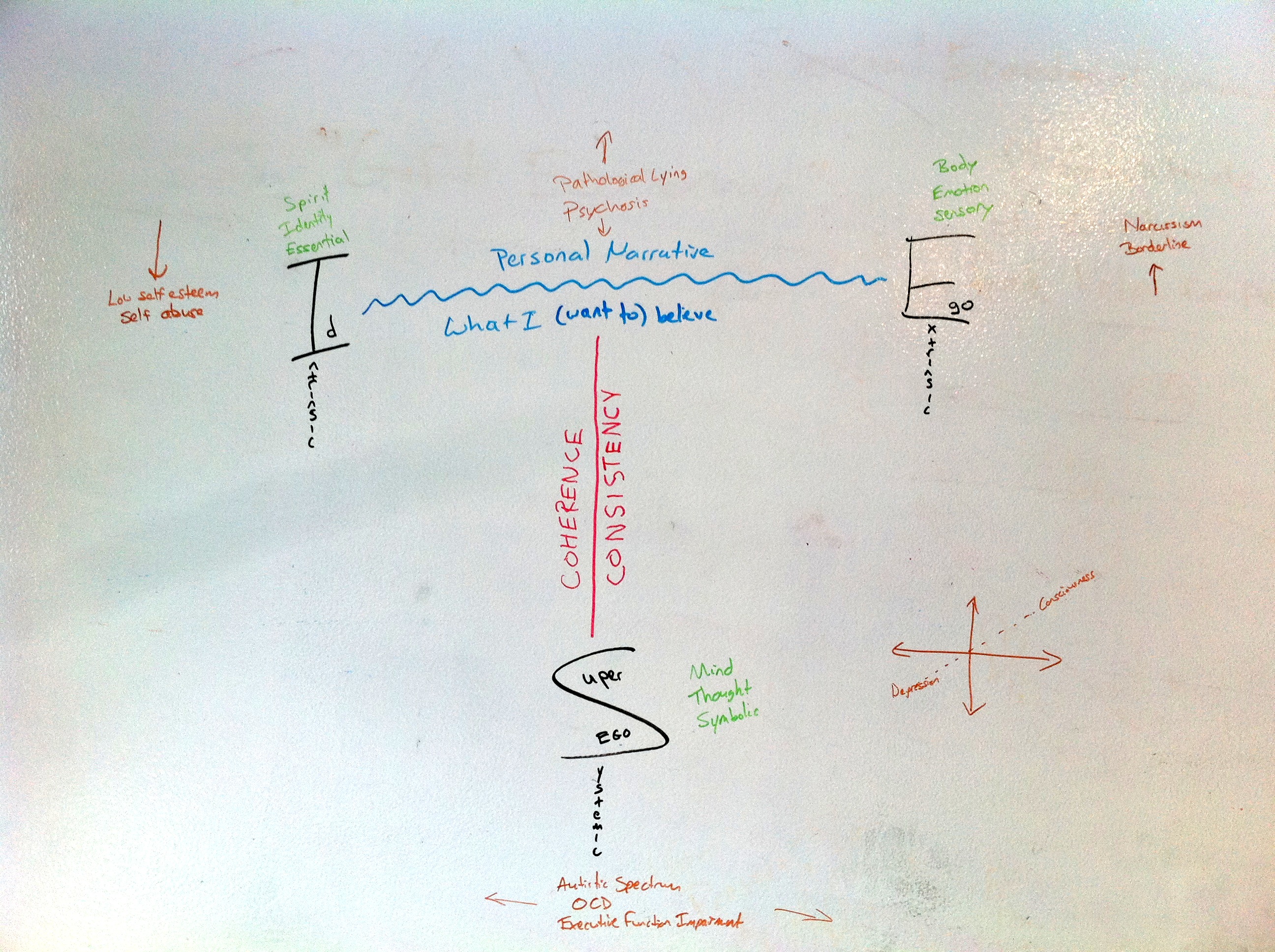
Over the last several years I’ve been digging into the science of cancer and systems biology, while at the same time looking at the epidemiology of disease and nutrition. And the more I learn, the more I’m convinced that there’s a gap that our scientific tools and methodologies cannot account for. While I’ve discussed this generally under the heading of Science 2.0 (also here), I’ve had a hard time putting into language the exact nature of the gap.
I’ve begun a series of posts that I hope will illustrate the gap, which I believe has to do with the fundamental difference between epidemiology (which is based on statistical observation) and etiology (which seeks to find causal mechanisms for observed phenomena):
- A1 vs. A2 Milk
- Medicine 2.0
- Sunlight vs. Vitamin D
- Animals vs. Plants
- Sugars
Once I’ve completed these posts, I’ll attempt to explain the nature of the gap and what it means for the future of scientific inquiry.…
Metaphysics
What fundamental truths exist in the universe?
This question, perhaps above all, is the basis for scientific inquiry. Yet we rarely ask it in this way and we rarely step back to the very basic assumptions we hold about the possible form of answer we might expect. For instance, is matter fundamental? Meaning, if we could not talk about particles and mass, could we understand the universe as well (or better) than we currently do?
Einstein showed that there is an equivalence between matter and energy (E=mc^2), but what does that really mean? Personally, I’m kinda stumped when it comes to understanding energy, and I suspect that many other people are too if they think about it. Then there’s that pesky c^2 part of the equation, which seems even more nebulous. Physics 101 tells us that c is the velocity at which light (a form of energy) travels, and that any velocity squared is acceleration. Also we learn that velocity is distance over time…
Why Falsifiability is Insufficient for Scientific Reasoning
In my post about The Process it turns out that I stepped on a pedagogical minefield when using describing the Anthropic Principle (AP). Two preeminent physicists had a very public argument a while ago in which one called the AP unscientific because it’s unfalsifiable. I will return to that in a moment since it’s the crux of what’s wrong with Science right now, but I need to get the terminology issue out of the way first.
Lee Smolin claims that AP is bad and favors a Cosmological Natural Selection view instead (on grounds of falsifiability). I believe this is a false dichotomy and that they are really one and the same. Here’s why:
- Normally natural selection requires some form of “replication” or it’s not actually natural selection. But replication is not needed if you start with an infinity of heterogeneous universes. In other words replication is simulated via the anthropic lens over the life-supporting subset of all possible universes.
- Replication is a red herring anyway
The Process
Imagine a multiverse, infinitely infinite. There’s just infinity. Or if you prefer, nothing. There’s no space, no time, no matter, no energy. There’s no structure whatsoever, and nothing “in” any of the universes that make up the multiverse. it’s not even clear whether these individual universes are separate from one another or the same. But since our minds seem finite and we have to start somewhere, let’s imagine them as separate: an infinite collection of universes with nothing in them, no dimension, and no relationship between them.
Now lets assume there is some process for picking out universes from the multiverse. Since there’s no time in the multiverse, the process has no beginning and no end. It’s like a computer program, but it’s infinitely complex. Let’s call it The Process.
If The Process is infinitely complex and has no beginning and no end, what can we know about it? We know that it picks some universes but not others, which effectively creates an “in …
Cancer as a Complex Adaptive System
Heng, et al recently published a review paper that brings together and touches on many different aspects of cancer complexity. I thought this an opportunity to selectively quote the paper and organize the quotes loosely around various complex systems concepts they relate to. I’m curious whether this makes sense to readers of this blog, or whether there’s too much unexplained jargon and too many large conceptual leaps. Please ask questions or make comments freely below.
One preface I think will help is to understand that genome, karyotype and chromosome refer roughly to the same thing. Here are several schematics that I will present without explanation that together illustrate how genes relate to genome/karyotype/chromosome structure, and how that in turn relates to the so-called genetic network (loosely equivalent to the “proteome”). Of course “gene” is an outdated and inaccurate concept, so don’t get too hung up looking for genes here, just understand that they are sub-structural elements of the genome.
From MSU website
Chasing the Dragon
Kevin just posted about a great article by Felix Salmon in Wired. I underlined three quotes in my reading of it:
- “Correlation trading has spread through the psyche of the financial markets like a highly infectious thought virus.” (Tavakoli)
- “…the real danger was created not because any given trader adopted it but because every trader did. In financial markets, everybody doing the same thing is the classic recipe for a bubble and inevitable bust.” (Salmon)
- “Co-association between securities is not measurable using correlation…. Anything that relies on correlation is charlatanism.” (Taleb)
Superfoo
Response to Superorganism as Terminology.
I was actually about to post something about terminology, so I’m glad this came up. It’s just so difficult to choose words to describe concepts that have little precedent, without going to the extreme of overloading on the one end (e.g. “organism”) or the other extreme of being totally meaningless (e.g. “foo”). I have tried to use terms that are the closest in meaning to what I’m after but there’s no avoiding the misinterpretation. I can only hope by defining and redefining to an audience that is not quick to make snap judgments but rather considers the word usage in context, we can converge to at least a common understanding of what I am claiming. From there at least we have a shot at real communication of ideas and hopefully even agreement.…
Response to "Superorganism Considered Harmful"
This is a response to Kevin’s post responding to my post.
…Rafe makes an analogy to cells within a multicellular organism. How does this support the assertion that there will only be one superorganism and that we will need to subjugate our needs to its own? Obviously, there are many multicellular organisms. Certainly, there are many single-celled organisms that exist outside of multicelluar control today. So where is the evidence that there will be only one and that people won’t be able to opt out in a meaningful sense?
Group Selection Meme on the Rise
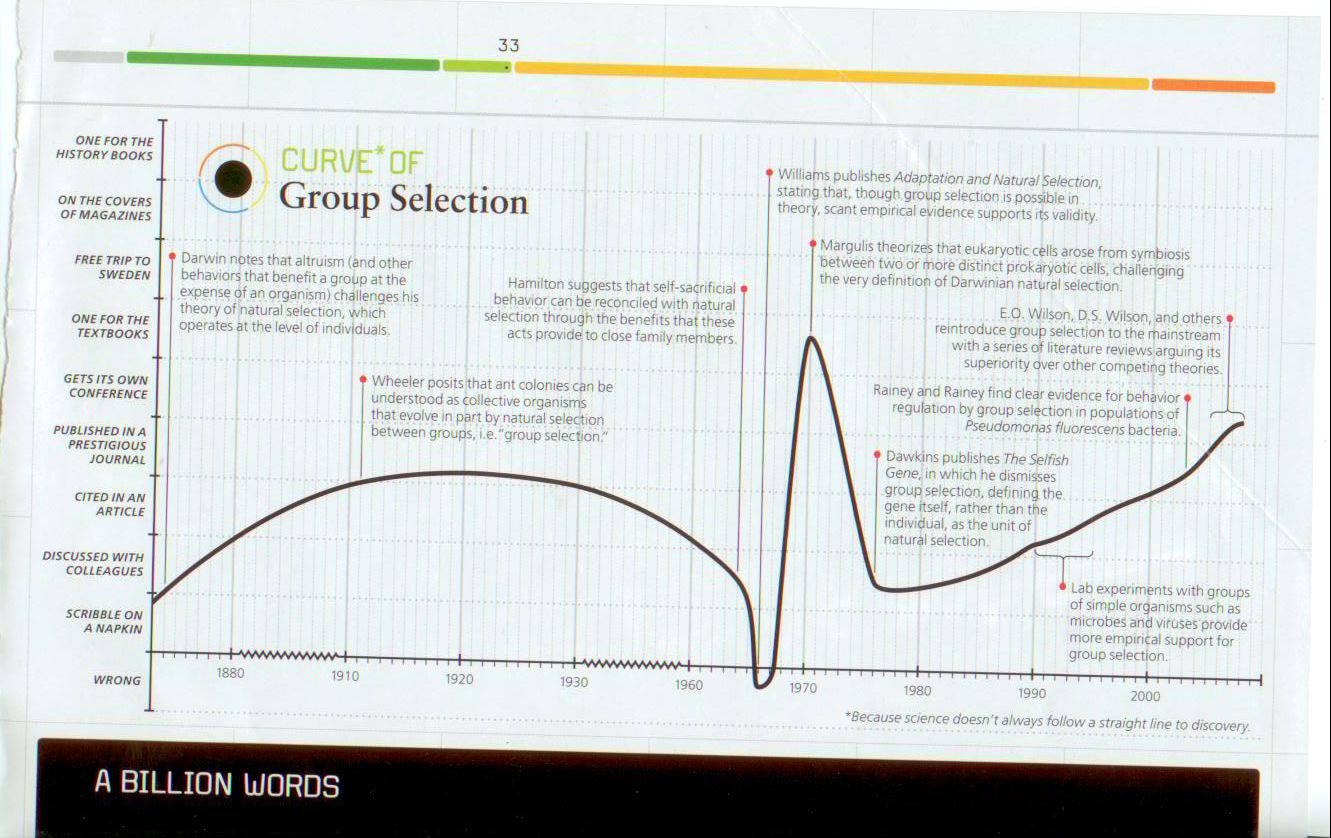
This is from a recent Seed Magazine article. Click on the image to enlarge it.…
Incidentalomas
An incidentaloma according to wikipedia is “a tumor (-oma) found by coincidence (incidental) without clinical symptoms or suspicion.” The provocative NY Times article below suggests that indolent tumors (i.e. ones that do not need treatment) may come and go as a normal part of life. With better detection tools, we are finding more and more of these. However our protocol for dealing with tumors is based on a time when tumors found were almost always non-incidental, non-indolent and requiring of positive action (like surgery). According to Dr. Donald A. Berry, chairman of the department of biostatistics at M. D. Anderson Cancer Center:
…It’s possible that we all have cells that are cancerous and that grow a bit before being dumped by the body. ‘Hell bent for leather’ early detection research will lead to finding some of them. What will be the consequence? Prophylactic removal of organs in the masses? It’s really scary.
The Conflict Between Complex Systems and Reductionism
The following is a recent paper by Henry Heng published in JAMA. I’ve linked concepts mentioned in the paper to corresponding explications from this blog.
JAMA. 2008;300(13):1580-1581.
The Conflict Between Complex Systems and Reductionism
Henry H. Q. Heng, PhD
Author Affiliations: Center for Molecular Medicine and Genetics, Wayne State University School of Medicine, Detroit, Michigan.
Descartes’ reductionist principle has had a profound influence on medicine. Similar to repairing a clock in which each broken part is fixed in order, investigators have attempted to discover causal relationships among key components of an individual and to treat those components accordingly. …
Predicting the 2008 Presidential Election
I am a fan of prediction markets. They have typically done much better than polls at predicting the outcome of elections. Why? Here’s a thought experiment. Consider who you think is going to win the election (not who you want to win). Now consider that I was going to bet you $10,000 of your hard earned money on whether your prediction comes true. Did that change your thinking at all? Some of you might have even switched candidates once money was on the line. That’s the difference between a poll and a prediction market.…
Go Forth and Reify
reify |ˈrēəˌfī|
verb ( -fies, -fied) [ trans. ] formal
make (something abstract) more concrete or real
Imagine if an alien landed on Earth to study modern society and you were assigned the task of being its local guide. You get to the subject of money and the alien is perplexed. What is money? Is it paper currency? Clearly not, since you can exchange that paper for other forms of currency, such as coins, foreign bank notes, electronic funds, treasury bills, and all sorts of derivatives, assets (both tangible and intangible, liquid and illiquid), services, promises, and so on. After hearing all of the various aspects of money, the alien tells you that money doesn’t really exist.…
Complex Systems Concept Summary
I figured it was time for a reset and so the following is a summary of much of the foundational posting that I’ve done on this blog so far. As always, a work in progress, subject to refinement and learning……
Hive Mindstein
David Basanta’s blog has an interesting thread (quite a few of them actually). Here’s the setup but you should read the original post, including the Wired article:
…Apparently, some people are seeing some potential in cloud computing not just as an aid to science but as a completely new approach to do it. An article in Wired magazine argues precisely that. With the provocative title of The end of theory, the article concludes that, with plenty of data and clever algorithms (like those developed by Google), it is possible to obtain patterns that could be used to predict outcomes…and all that without the need of scientific models.
Sigmoids vs Exponentials
In a previous post, I argued that we humans suffer from a destructive oversimplifying habit of linear extrapolation. This professor argues the same point, but he falls into the next logical trap, thinking that exponential extrapolation solves the problem.…
Global Warming
A few months ago a friend of mine engaged me in a discussion about the controversy surrounding global warming. If you are surprised to hear that there is still controversy, read on; I was equally surprised.…
Seeing Sigmoids
One of the most basic but misleading heuristics that the human mind uses is that of linearity. If we see a progression (say 0, 1, 2), our first instinct is that the next step follows linearly (namely 3). But there is no a priori reason to prefer the linear interpretation to any other, say quadratic (which would suggest the next step in the sequence is 4). For whatever reason – probably due to the relative simplicity of linearity – our brains seem wired to prefer linear explanations to non-linear.…