Cooperation
Lo@n, D*bt and Other Four-Letter Words
Prior to the mid-19th century, those who could not pay their debts were routinely tossed into prison. Actually, you can still go to debtor’s prison in Germany, Greece, China and Dubai. In the United States, two of the signatories to the Declaration of Independence (James Wilson and Robert Morris) were incarcerated for their unpaid debts. In theory, the U.S. abolished such practices in the 1830s. But six states still allow you to be arrested and detained indefinitely until you “work it out” with your creditors.
And while we humans seem to have a visceral negative reaction to welshers, our disdain for bad faith lenders goes deeper. Condemnation of usury dates back to the Vedic texts in ancient India, and is condemned as well in all the other major religious texts in the world. Islamic law (Sharia) prohibits the charging of interest at all, and considers the practice to be one of the seven heinous sins, right up there with murder and “unlawfully taking an orphan’s …
How to Be a Good Representative
Are you someone who has been given (and accepted) responsibility for someone else’s well-being? Maybe you are an elected official? A board member? A parent? A friend? If so, you may resonate with the following realization I just had about my own successes and failures in the role of Representative.
I used to believe that what a Representative does is to act and react as if they were the one being represented. I felt like my job was to get inside their head, and channel them, sort of like a medium or a conduit. The problem with this though is it always ends badly. Why? Because it’s an impossible job.
Nobody can speak for you, as if they were you. Sure, if you know one another really, really well, then at times it can seem as though they read your mind, know what’s in your heart. But the times I have been most frustrated in any relationship is when the other person believes and acts …
The Adjacent Possible
Stuart Kauffman has a concept called the Adjacent Possible which I find incredibly useful in understanding the world. Simply put, if you think of the space of possibilities from the present moment forward and just concentrate on those that are achievable today — adjacent to the present moment — that’s the Adjacent Possible.
What’s interesting about possibility-space is that tomorrow’s Adjacent Possible depends on the actions and choices we make today; it’s not symmetric and it’s nonlinear. Certain actions generate more future possibilities than others. In my experience, those actions tend to be the cooperative ones, ones that produce network effects: financial, social and otherwise.
Due to our evolutionary heritage, having come from a resource-constrained world, we may be predisposed to see the more competitive actions which tend to shrink the Adjacent Possible. Whether or not this is a bias or an actual state of affairs, much of our thinking is based on scarcity, so we are drawn to actions that become self-limiting.
Here’s …
The Process
Imagine a multiverse, infinitely infinite. There’s just infinity. Or if you prefer, nothing. There’s no space, no time, no matter, no energy. There’s no structure whatsoever, and nothing “in” any of the universes that make up the multiverse. it’s not even clear whether these individual universes are separate from one another or the same. But since our minds seem finite and we have to start somewhere, let’s imagine them as separate: an infinite collection of universes with nothing in them, no dimension, and no relationship between them.
Now lets assume there is some process for picking out universes from the multiverse. Since there’s no time in the multiverse, the process has no beginning and no end. It’s like a computer program, but it’s infinitely complex. Let’s call it The Process.
If The Process is infinitely complex and has no beginning and no end, what can we know about it? We know that it picks some universes but not others, which effectively creates an “in …
Synthesis of Complexity Theory
As careful readers of this blog will note, I’ve been obsessed with Alex Ryan’s visualization of the way new levels of organization come into being (e.g. atoms -> molecules -> cells, etc). In an attempt to complement and extend his model, here’s a visualization of how I think of the various concepts coming together:
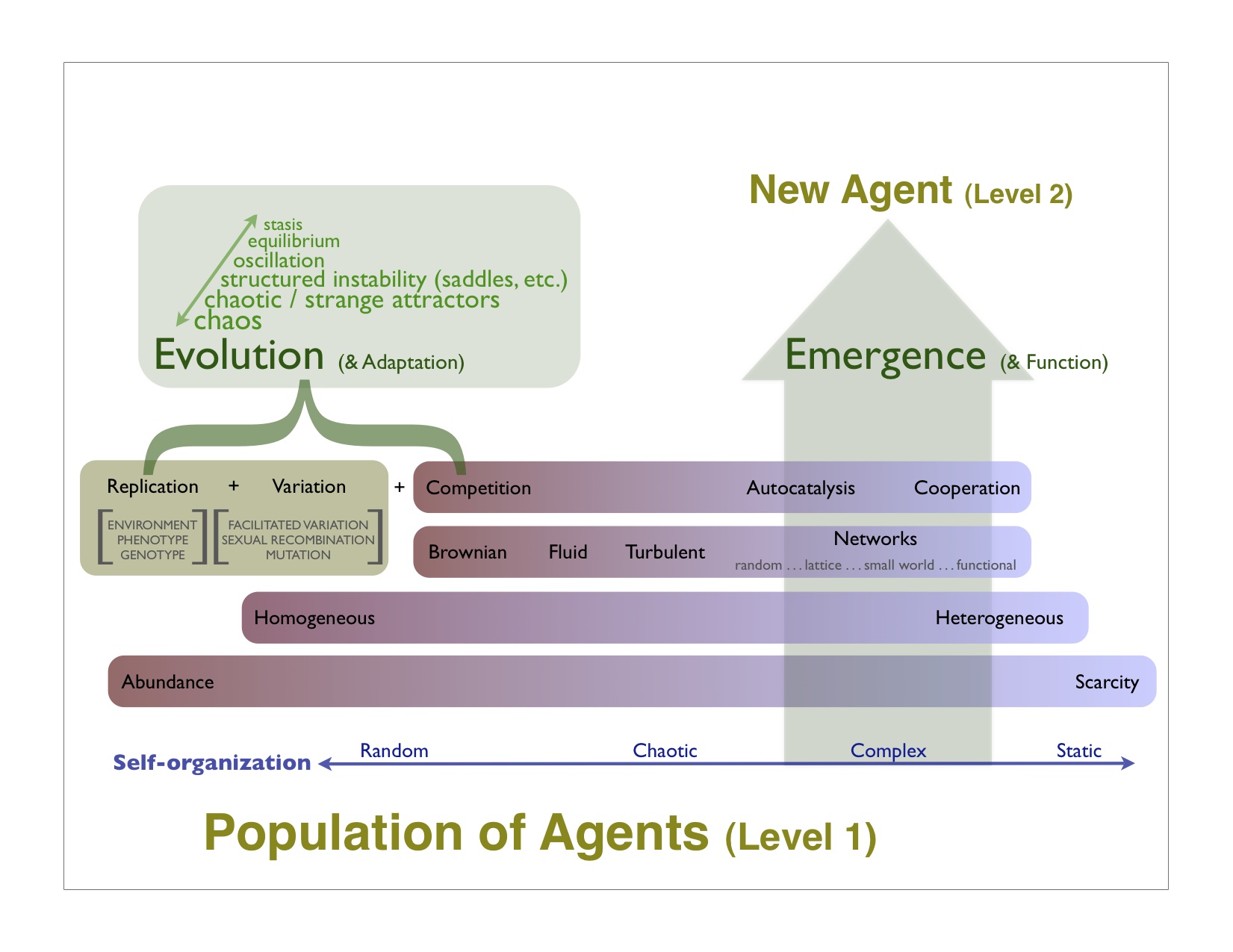
First off, I know that this may not make sense to most people. The relationships implied by proximity, color, dimension, etc are not totally accurate. The problem is, I’ve reached the limit of my personal ability to create a good visualization. So I’m throwing this out there half-baked hoping that the crowd (that’s you) will help bring this together in a more coherent way.
I’m especially interested in hearing from people who have great design skills. If you don’t, then at the least you can ask probing questions to suss out the sources of confusion, which will then feed into the redesign process.
A more detailed explication of these concepts can …
“Social Entrepreneurship has Complexity Written All Over It”
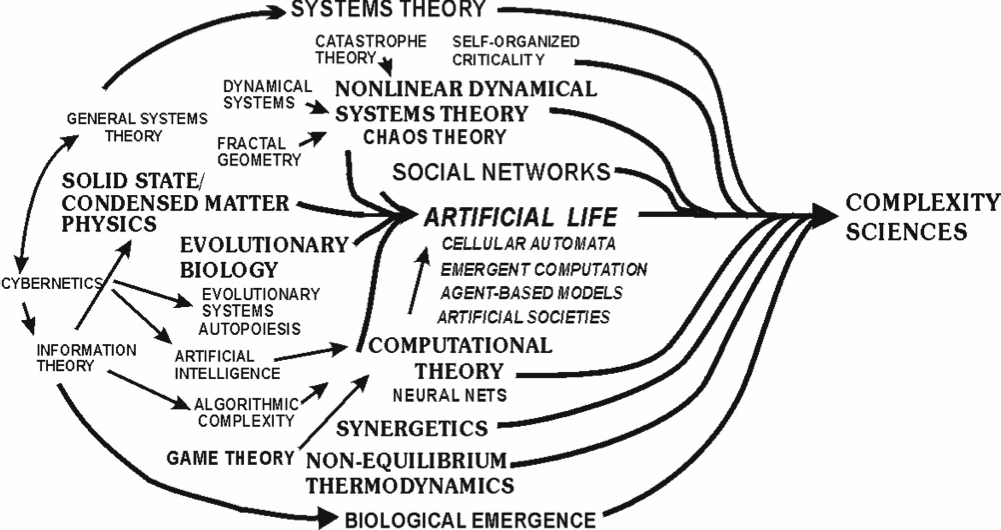
That’s the title and conclusion of this paper by Jeffrery Goldstein et al which was presented at this talk at the Skoll Foundation International Social Innovation Conference 2009. Here’s a slide from that talk that I like:
If you like the theme of “Social Entrepreneurship, Systems Thinking and Complexity” — and I know that you do because that’s what this blog talks about a lot of the time — then you may want to attend (or even submit a paper/talk abstract to) the eponymously named conference at Adelphi University in New York (April 30 - May 2, 2010). Hope to see you there!
hat tip: Jerri Chou: @jchou…
Convergence
As readers of my blog posts know, I talk a lot about evolutionary systems, the formal structure of cooperation, the role of both in emergence of new levels of complexity, and I sometimes use cellular automata to make points about all these things and the reification of useful models (here’s a summary of how they all relate). I’ve also touched on this “thing” going on with the system of life on Earth that is related to technological singularity but really is the emergence or (or convergence) of an entirely new form of intelligence/life/collective consciousness/cultural agency, above the level of human existence.
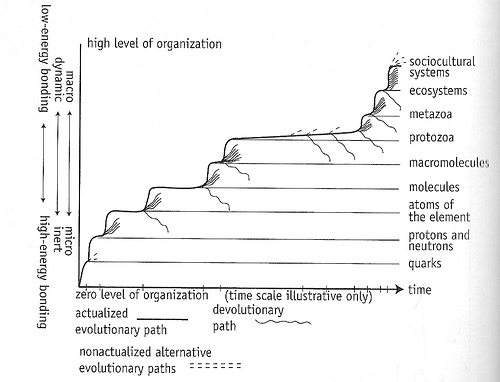
From The Chaos Point. Reproduced with permission from the author.
In a convergence of a different sort, many of these threads which all come together and interrelate in my own mind, came together in various conversations and talks within the last 15 hours. And while it’s impossible to explain this all in details, it’s really exciting to find other people who are on …
Inoculating Against the Anti-Vaccine Meme
The debate over vaccination is raging (c.f. Wired article) and it smacks of one of those conundrums that is unlikely to get resolved by scientific inquiry. I offer the following hypothesis and a way out of the dilemma.
Hypothesis: Vaccination is something that is good at the societal level but bad at the individual level. That is, it is a tragedy of the commons. You want all your neighbors to get vaccinated so they don’t pass on the germs to you, but there is enough risk from the vaccination process (at least for certain ones) that you’d rather not do it yourself.
The mathematics of the commons tragedies suggests that there are two ways out. One is to change the payout/incentive structure, in other words, make the vaccine’s less risky to the individual, or at least change the perception of the individual risk (as the Wired article suggests). The problem with manipulating perception is, what if you’re wrong? The marketplace of ideas …
What Obama Needs to Do
The old philosophical theory says that reason is conscious, can fit the world directly, is universal (we all think the same way), is dispassionate (emotions get in the way of reason), is literal (no metaphor or framing in reason), works by logic, is abstract (not physical) and functions to serve our interests. Language on this view is neutral and can directly fit, or not fit, reality.
The scientific research in neuroscience and cognitive science has shown that most reason is unconscious. Since we think with our brains, reason cannot directly fit the world. Emotion is necessary for rational thought; if you cannot feel emotion, you will not know what to want or how anyone else would react to your actions. Rational decisions depend on emotion. Empathy with others has a physical basis, and as much as self-interest, empathy lies behind reason.
This is part of a brilliant article by cognitive science and linguistics pioneer, George Lakoff (emphasis mine). His argument about what …
The Diamond Rule
We all know the Golden Rule: do unto others as you would have them do unto you. TED Prize Wish winner, Karen Armstrong, even laudably proposed that a Charter for Compassion based on the observation that all three Abrahamic traditions (Christianity, Judaism and Islam) have the Golden Rule at their core.
I do believe that if we all followed the Golden Rule as the basis for how we treat one another the world would be a better place. But I also think there is a a more fundamental rule, call it the Diamond Rule, which is even better:
Treat others as you believe they would want you to treat them, if they knew everything that you did.
The difference is subtle, and may not practically speaking yield different action that often. But when it does, the difference can be significant.…
Physics.Cancer.GOV
Yesterday, from the Director of the National Cancer Institute, addressing one of the two largest cancer research conferences of the year:
NCI commenced a series of workshops that began to bring aspects of the physical sciences to the problem of cancer. We discussed how physical laws governing short-range and other forces, energy flows, gradients, mechanics, and thermodynamics affect cancer, and how the theories of Darwinian and somatic evolution can better help us understand and control cancer.
Read more on my Cancer Complexity Forum post.…
If Rafe Were In Charge: Major Medical Edition
Kevin started an interesting discussion that included a thoughtful proposal for the problem of major medical care costs risk mitigation. You should read that here before reading my proposal below.
Part 1: Major Medical Annuities. Federally mandated/funded (similar to SSI/Medicare), with a specific initial lifetime value that is the same for everyone. The concept is that you pick a number slightly bigger than the average expected lifetime major medical bill and set aside that pot of money for everyone individually. At some point (e.g. 65) you can choose to start drawing down from your pot as taxable income. Prior to then, the only way the fund can be used is for major medical expenses not covered by other insurance you may have. Such payments go directly to providers and are tax-exempt. When you die, any leftover amount gets transferred to the MMA accounts of your heirs (per your desired breakdown, or according to probate law in the absence of a will).…
Asymmetry Is the Root of All Value
It’s not hard these days to find vignettes like this one (starting at minute 1:45) that describe a microeconomic chain of events that give you a glimpse into the recessionary dynamic. I think it’s a good starting point to explain my personal theory of why asymmetry is the root of all value (economic and otherwise).…
The Vanguard of Science: Bonnie Bassler
The import of this talk goes way beyond the specific and stunning work that Bassler and her team have done on quorum sensing. In my mind, this is the prototype for good biological science:…
Tribes
Tribes are hot.
Kevin has referred more than once to the famous Dunbar number for limits on optimal human tribe size.
One of my favorite books recently is Seth Godin’s book on leadership, called — you guessed it — Tribes.
Yesterday I heard a great talk by David Logan, co-author of Tribal Leadership.…
Red Pill or Blue Pill?
As we approach the inauguration of a new leader who trying to be truly post-partisan, I think Jonathan Haidt’s TED brilliant talk is apropos:…
The Conflict Between Complex Systems and Reductionism
The following is a recent paper by Henry Heng published in JAMA. I’ve linked concepts mentioned in the paper to corresponding explications from this blog.
JAMA. 2008;300(13):1580-1581.
The Conflict Between Complex Systems and Reductionism
Henry H. Q. Heng, PhD
Author Affiliations: Center for Molecular Medicine and Genetics, Wayne State University School of Medicine, Detroit, Michigan.
Descartes’ reductionist principle has had a profound influence on medicine. Similar to repairing a clock in which each broken part is fixed in order, investigators have attempted to discover causal relationships among key components of an individual and to treat those components accordingly. …
Complex Systems Concept Summary
I figured it was time for a reset and so the following is a summary of much of the foundational posting that I’ve done on this blog so far. As always, a work in progress, subject to refinement and learning……