Medical Breakthroughs
A New Cancer Mentality
This interview was done as part of the New Cancer Mentality initiative:
New Cancer Mentality is a grassroots organization focused on giving cancer patients a virual townhall to ask their questions to leading oncologists and researchers about their work. Furthermore, New Cancer Mentality focuses on bringing about collaboration between researchers as well as giving researchers an online forum to share their views and what needs to be done to cure this disease.
If you’d like to learn more or join the movement, check out blog and contact David.…
Biological Immortality
There’s a scientific paradox in the world of nutrition about what the optimal diet is. A new theory may resolve the paradox. Oh, and help you live forever too.
The majority consensus is the “post-agricultural revolution diet” is best, which says that a majority of your intake should be vegetables and fruits, and that you should severely limit your animal product intake, especially red meats. Some proponents (like T. Colin Cambell of China Study fame) go as far as claiming that a strictly vegan diet is best.
The other camp argues for the “paleo” or “caveman” diet, which says we need to eat what our paleolithic ancestors ate: lots of foods high in animal fat and animal protein, and avoid industrialized grains altogether (some fermented natural grains are fine). Fermented foods in general are encouraged, honoring the fact that before preservation, refrigeration and pasteurization we evolved a symbiosis with bacterias that are critical for our digestion and processing of nutrients.
Both sides agree that processed …
Approaching a Cure for Cancer
James Watson, co-discoverer of DNA’s double-helix structure recently called for a back to basics approach in dealing with cancer. In previous post threads I’ve discussed cancer’s complexity and in particular the confounding and scary implications of somatic evolution, which underscores some of the reasons we are not winning the “war on cancer.” Here I will discuss some cutting edge approaches to treating and preventing cancer and how they might pan out in light of the complexities of the disease. The categories below are not mutually exclusive, and the examples cited are nowhere near exhaustive, but this should give you some food for thought. If you have ideas, questions or know of approaches that should be highlighted, please comment.
Target & Kill Approaches
Biris and Zharov are making some exciting progress in using nanotubes to tag and then track cancer cells inside the body as they move around. They propose to kill the cancer cells by heating up the nanotubes using lasers, while others are …
Homo Evolutis
In Juan Enriquez’ TED talk earlier this year, he made the point that humans have entered a new phase of evolution, one that has not been seen on before modern humans and their technology. This, of course, is one of the main theses of Ray Kurzweil’s book, The Singularity is Near, and the main justification for the creation of The Singularity Institute (plus related Singularity Summit), and now just recently, Singularity University.
Lest you think the concept of Homo Evolutis — a species that can control its own evolutionary path by radically extend healthy human lifespan and ultimately merging with its technology — is a fringe concept share by sci-fi dreamers who don’t have a handle on reality, check out the list of people in charge of Singularity University (link above), the Board members of the Lifeboat Foundation, and throw in Stephen Hawking for good measure, who says, “Humans Have Entered a New Phase of Evolution“. These people not only …
Foldit
Has anyone played Foldit, the protein-folding game that is designed to advance the science? This Wired article makes it sound like Ender’s Game meets biochemistry! Sounds like the Poehlman kid is the protein-folding equivalent of Stephen Wiltshire. I love the crowdsourcing, the meta-evolutionary algorithm of it (to find the savants), and the implications for science.…
Methuselah Foundation
If, like Aubrey de Grey, you believe that immortality is achievable, or you are just intrigued by the possibility, you should check out this news story on The Methuselah Foundation.
…
The Vanguard of Science: Bonnie Bassler
The import of this talk goes way beyond the specific and stunning work that Bassler and her team have done on quorum sensing. In my mind, this is the prototype for good biological science:…
Placebos Work Even If You Don't Believe in Them
This is one of the most important medical “breakthroughs” in recent memory. You should read the entire article, because it makes some subtle points, but the upshot is that placebo has (at least) two components, one that is triggered by conscious belief in a putative cure, and another that is triggered by unconscious, Pavlovian association.…
Preventing Cancer Through DNA Replacement?
On the Cancer Complexity forum, I pose a question: if we could somehow replace all the damaged DNA in each of the cells of your body with an undamaged copy on a continuous basis, would that prevent you from getting cancer?
What do you think?…
Coffee Linked to Lower Dementia Risk
The NY Times reports.
Here’s my theory: someone who drinks more than three cups of coffee a day can’t possibly sit still and actually gets their ass off the couch and does shit, thereby stimulating the body and brain, a known and powerful way to reduce dementia risk.
hat tip: Daniel Horowitz…
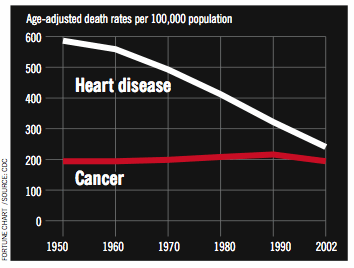
Cancer as Evolution, part 4
For those who missed the first three parts:
Any underlying theme of this thread is how reliance on reductionism causes us to miss the key invisible etiologies that are necessary to make progress on understanding, treating, detecting and preventing cancer.
In the first three parts of this series, I pointed out how the invisible etiology of somatic evolution has great explanatory and predictive power for oncology. A new paper by some researchers on the vanguard of complex systems thinking shows how adding a complementary ecological model leads us to the promising approach of ecological therapy.
A Nature Review article published a couple of years ago summarizes the case for cancer as an evolutionary and ecological process
hat tip: David Basanta…
Hina Chaudhry
Like does this mean you can cure heart disease?
She’s hesitant. Nobody wants to say they can defeat the industrialized world’s number one killer. Nobody wants to make promises about life, or quantify salvation. But she fervently believes she’s got a shot.
This is what the 2008 Genius edition of Esquire Magazine had to say about Hina Chaudhry. Her approach is to switch back on the mechanism that causes cells to divide in the heart, which doesn’t normally happen after birth in any mammal. This is not a stem-cell approach, despite what it might sound like.
Looking on the web there appears to be very little written about this work, so I’m wondering how Esquire found her or chose her work to highlight. I’d like to learn more if anyone has information they’d like to share.…
Incidentalomas
An incidentaloma according to wikipedia is “a tumor (-oma) found by coincidence (incidental) without clinical symptoms or suspicion.” The provocative NY Times article below suggests that indolent tumors (i.e. ones that do not need treatment) may come and go as a normal part of life. With better detection tools, we are finding more and more of these. However our protocol for dealing with tumors is based on a time when tumors found were almost always non-incidental, non-indolent and requiring of positive action (like surgery). According to Dr. Donald A. Berry, chairman of the department of biostatistics at M. D. Anderson Cancer Center:
…It’s possible that we all have cells that are cancerous and that grow a bit before being dumped by the body. ‘Hell bent for leather’ early detection research will lead to finding some of them. What will be the consequence? Prophylactic removal of organs in the masses? It’s really scary.
Metabolism Boosters
Pop Quiz: what are the four ways that vegetables and fruits act as a superstar health shield? Find out here.
Click here for more Dr. Ann videos.…
The Conflict Between Complex Systems and Reductionism
The following is a recent paper by Henry Heng published in JAMA. I’ve linked concepts mentioned in the paper to corresponding explications from this blog.
JAMA. 2008;300(13):1580-1581.
The Conflict Between Complex Systems and Reductionism
Henry H. Q. Heng, PhD
Author Affiliations: Center for Molecular Medicine and Genetics, Wayne State University School of Medicine, Detroit, Michigan.
Descartes’ reductionist principle has had a profound influence on medicine. Similar to repairing a clock in which each broken part is fixed in order, investigators have attempted to discover causal relationships among key components of an individual and to treat those components accordingly. …
From the Heart
I have a bicuspid aortic valve, a congenital condition which exists in up to 2% of the general population:
…