Psychology
Innovation as Moral Leverage
“Never doubt that a small group of thoughtful, committed, citizens can change the world. Indeed, it is the only thing that ever has.” (Margaret Mead)
“Be the change you want to see in this world” (Gandhi)
There is an idea virus within American culture that has the power to destroy. The idea is that technology and innovation are fundamentally good. Whether you consider yourself a technologist, an entrepreneur or a scientist (all labels I use to identify myself at times) I’d like to propose an alternative to to this idea and an inoculation against the virus.
Observation #1: Innovation amplifies whatever values and beliefs are held by the innovator.
For instance, if I value my time, I might invent the first clock, or start a business to create time-management products, or devote my life to unlocking deep mysteries of the physics of time. And if I believe clean drinking water is a fundamental human right, I might invent a new method of water purification, or …
What is Fear?
Based on an informal assessment and polling I’ve done recently, here’s what we fear:
- Identity
- LOSING ONESELF
- Death / Pain / Insignificance
- BEING WRONG
- Self-Exploration / Failure / Change
- INAUTHENTICITY
- Being Found Out / Self-Expression / Lying
- LOSING ONESELF
- Control
- EMOTIONAL
- Power / Anticipation / Fear-Itself
- OTHERS
- Intimacy / Just Doing It / (Lack of) Freedom
- THE UNCONTROLLABLE
- Disaster / Crisis / Unknown-Unknowns
- EMOTIONAL
- Authority
- RIGHTS
- Being Unworthy / Unmet Expectation / Meaninglessness
- MORALITY
- Unfairness / Inequality / Injustice
- RULES
- Doing it Wrong / Shame / Guilt
- RIGHTS
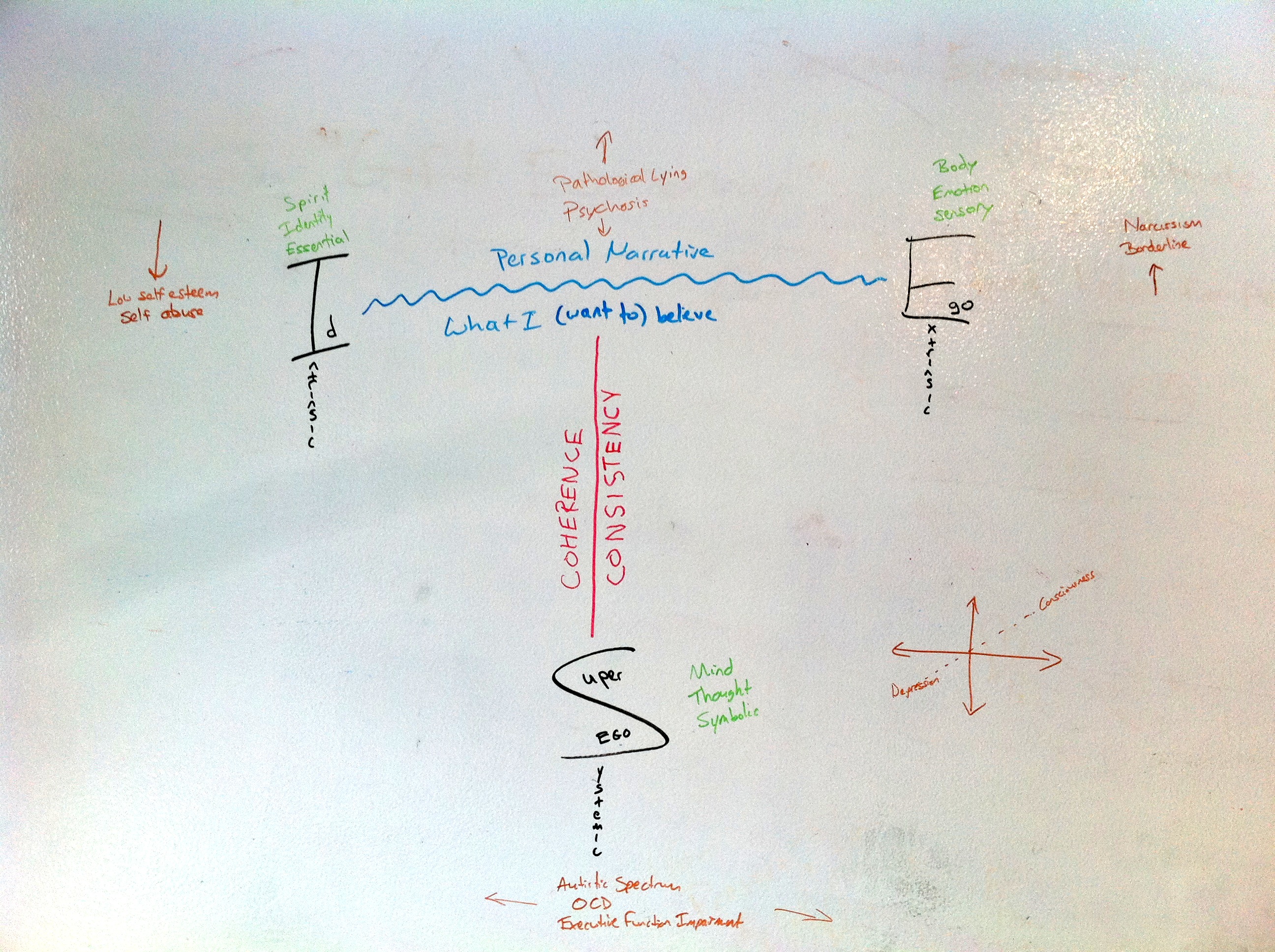
Each of us has a unique profile of what fear is depending on how we related to various value dimensions (intrinsic, extrinsic and systemic). For me the scariest are: (1) Unknown-Unknowns (2) Power (3) Being Wrong (4) Self-Expression (5) Injustice
How about you?…
The Secret to a Great TED Talk
Recently I learned from two separate people how the Obama campaign won the 2008 presidential election and it’s fascinating. Basically everyone who was a part of it learned the “campaign narrative” structure and delivered their personal message to spread the gospel:
- The Story of Me: why I’ve personally been inspired by this campaign
- The Story of We: why we (me speaking and you listening) are united and inspired by this campaign
- The Story of Now: why it’s urgent that you take action now; the train is leaving and you can jump aboard or be left behind
If you think about it, this is a very powerful narrative for creating grass-roots action of any sort. Having just spent the last week watching many dozens of TED talks (and having watched hundreds of them over the past few years), I’ve been thinking about the fact that the great ones all follow a shared structure, which I will share with you now:
- The Story of
The AI-Box Experiment
Several years ago I became aware of Eliezer Yudkowsky’s “AI-Box Experiment” in which he plays the role of a transhuman “artificial intelligence” and attempts (via dialogue only) to convince a human “gatekeeper” to let him out of a box in which he is being contained (resumably so the AI doesn’t harm humanity). Yudkowsky ran this experiment twice and both times he convinced the gatekeeper to let the AI out of the box, despite the fact that the gatekeeper swore up and down that there was no way to persuade him to do so.
I have to admit I think this is one of the most fascinating social experiments ever conceived, and I’m dying to play the game as gatekeeper. The problem though that I realize after reading Yudkowsky’s writeup is that there are (at least) two preconditions which I don’t meet:
Currently, my policy is that I only run the test with people who are actually advocating that an AI Box be used …
Medicine 2.0
Kim Scheinberg sent me a great article from The Atlantic that relates to my multi-thread rant on epidemiology. Since the article speaks for itself, I’m just quoting points I think are salient. The only words below that are not a direct quote are the headlines (i.e. “Did you know?”). The emphasis is mine as well.
Did you know?
- mammograms, colonoscopies, and PSA tests are far less useful cancer-detection tools than we had been told
- Zoloft, and Paxil were revealed to be no more effective than a placebo for most cases of depression
- staying out of the sun entirely can actually increase cancer risks
- taking fish oil, exercising, and doing puzzles doesn’t really help fend off Alzheimer’s disease
Medicine has caught a plague
…we think of the scientific process as being objective, rigorous, and even ruthless in separating out what is true from what we merely wish to be true, but in fact it’s easy to manipulate results, even unintentionally or unconsciously.
There is an
The Safety Net
The following story is true, I’ve just changed the names and told it in parable form. The material numbers and circumstances are roughly accurate, and Alice is a friend of mine who may tell the story herself on video here soon…
A True Story
Alice was feeling particularly poor at a certain time in her life and because of this she was under a lot of stress. Her friend, Bob, was a billionaire many times over and he disliked seeing his friend in pain and so he wrote her a blank check and said, “Alice, whatever amount you cash this for, it will relieve me of the burden of figuring out what to do with it. Will you do me the favor of accepting this gift?” Alice was stunned because she knew she could have cashed the check for $30 Million and Bob would not have missed it at all. And she knew Bob was sincere in what he was saying.
Alice was overwhelmed with …
Inoculating Against the Anti-Vaccine Meme
The debate over vaccination is raging (c.f. Wired article) and it smacks of one of those conundrums that is unlikely to get resolved by scientific inquiry. I offer the following hypothesis and a way out of the dilemma.
Hypothesis: Vaccination is something that is good at the societal level but bad at the individual level. That is, it is a tragedy of the commons. You want all your neighbors to get vaccinated so they don’t pass on the germs to you, but there is enough risk from the vaccination process (at least for certain ones) that you’d rather not do it yourself.
The mathematics of the commons tragedies suggests that there are two ways out. One is to change the payout/incentive structure, in other words, make the vaccine’s less risky to the individual, or at least change the perception of the individual risk (as the Wired article suggests). The problem with manipulating perception is, what if you’re wrong? The marketplace of ideas …
The Link Between Food & Healthcare Reform
Also must-read this Sunday is Michael Pollan’s NY Times Op-Ed piece from Wednesday. Nice cap to my week of ranting on the dismantling of rationality when it comes to lifestyle choices that directly impact one’s health, here and here.…
“Bad people do bad things”
In listening to this account of Hemant Lakhani, convicted in 2005 of illegal arms dealing, I was reminded of another This American Life episode about Brandon Darby. Underlying both stories are accounts of seemingly incompetent, misguided, would-be bad guys who were actualized on a path of evildoing by law-enforcement agents during sting operations.
What I found most interesting was the quote in the title of this post, said by the prosecutor in the Lakhani case. This was his justification for why it was okay to have the U.S. military supply Lakhani the weapon that he was convicted of illegally dealing. (If you listen to the story you will learn that Lakhani had been making promises to the informant of being able to procure weapons for a long time and he’d been unsuccessful on his own).
While it seems on the surface that “bad people do bad things” — i.e. that’s how bad things get done, they require a bad person to do them — …
What Obama Needs to Do
The old philosophical theory says that reason is conscious, can fit the world directly, is universal (we all think the same way), is dispassionate (emotions get in the way of reason), is literal (no metaphor or framing in reason), works by logic, is abstract (not physical) and functions to serve our interests. Language on this view is neutral and can directly fit, or not fit, reality.
The scientific research in neuroscience and cognitive science has shown that most reason is unconscious. Since we think with our brains, reason cannot directly fit the world. Emotion is necessary for rational thought; if you cannot feel emotion, you will not know what to want or how anyone else would react to your actions. Rational decisions depend on emotion. Empathy with others has a physical basis, and as much as self-interest, empathy lies behind reason.
This is part of a brilliant article by cognitive science and linguistics pioneer, George Lakoff (emphasis mine). His argument about what …
Something Fishy About Mercury
Here is a fascinating discussion on NPR’s Forum from earlier this year on the subject of mercury and fish:
Audio clip: Adobe Flash Player (version 9 or above) is required to play this audio clip. Download the latest version here. You also need to have JavaScript enabled in your browser.
AudioPlayer.embed("audioplayer_1", {soundFile:"aHR0cDovL3d3dy5rcWVkLm9yZy8uc3RyZWFtL2Fub24vcmFkaW8vZm9ydW0vMjAwOS8wMi8yMDA5LTAyLTI2Yi1mb3J1bS5tcDM"});
If you’ve listened to this the whole way through (which you should), I’m curious as to how it will affect your habits, if at all. And why?…
Paying Women to Not Get Pregnant
What’s fascinating to me about this is not that it works so well and or that there might actually be support in the Obama administration for doing it on a national scale, but rather that there has not been a backlash against it yet. What are the odds that something like this will actually get implemented? Is it actually a good thing?
hat tip: Annie Duke’s mom…
Don't Eat That Marshmallow!
Short but brilliant TED talk by Joachim de Posada. I love the economic point he makes at the end.
…
Behavioral Economics With Dan Ariely
If you liked this talk (as I do), check out Ariely’s 3 irrational lessons from the Bernie Madoff scandal.…
Placebos Work Even If You Don't Believe in Them
This is one of the most important medical “breakthroughs” in recent memory. You should read the entire article, because it makes some subtle points, but the upshot is that placebo has (at least) two components, one that is triggered by conscious belief in a putative cure, and another that is triggered by unconscious, Pavlovian association.…
Crohn's Disease
Debbie Maier asks us on the Upcoming Topics page to address Crohn’s Disease.
I don’t know too much about it except that it’s an autoimmune disease and has a complex, multi-causal etiology and pathology. In my reading on autoimmune diseases in general there seems to be a direct link between latitude an incidence. Specifically, the farther from the equator you live the more likely you are to get Crohn’s, Type 1 diabetes, rheumatoid arthritis, and so on.…
Chasing the Dragon
Kevin just posted about a great article by Felix Salmon in Wired. I underlined three quotes in my reading of it:
- “Correlation trading has spread through the psyche of the financial markets like a highly infectious thought virus.” (Tavakoli)
- “…the real danger was created not because any given trader adopted it but because every trader did. In financial markets, everybody doing the same thing is the classic recipe for a bubble and inevitable bust.” (Salmon)
- “Co-association between securities is not measurable using correlation…. Anything that relies on correlation is charlatanism.” (Taleb)
Twitter vs. Psychoanalysis
In this Times Online article, two psychologists and an author weigh in with their view of Twitter users as narcissistic and infantile:
…The clinical psychologist Oliver James has his reservations. “Twittering stems from a lack of identity. It’s a constant update of who you are, what you are, where you are. Nobody would Twitter if they had a strong sense of identity.”
“We are the most narcissistic age ever,” agrees Dr David Lewis, a cognitive neuropsychologist and director of research based at the University of Sussex. “Using Twitter suggests a level of insecurity whereby, unless people recognise you, you cease to exist. It may stave off insecurity in the short term, but it won’t cure it.”
For Alain de Botton, author of Status Anxiety and the forthcoming The Pleasures and Sorrows of Work, Twitter represents “a way of making sure you are permanently connected to somebody and somebody is permanently connected to you, proving that you are alive. It’s like when a parent goes
Why It's Important to be an Optimist
The optimist proclaims that we live in the best of all possible worlds; and the pessimist fears this is true. (James Branch Cabell)
I am currently reading What Are You Optimistic About?, a collection of short essays by thought leaders in many different disciplines on the eponymous subject. I’m also reading True Enough, a compelling argument by Farhad Manjoo for how despite — nay, because of — the fire hose of information that permeates modern society and is available for the asking, the schism between what’s true and what we believe is widening; a polemic on polemics if you will. Taken together, these two books suggest to me that there is a case, not for being optimistic per se, but for why you should consciously, actively try hard to become an optimist if you aren’t already.…
Red Pill or Blue Pill?
As we approach the inauguration of a new leader who trying to be truly post-partisan, I think Jonathan Haidt’s TED brilliant talk is apropos:…