Emergence
Will the Next Unicorn be a Distributed Autonomous Organization?
With the recent talk of reddit being cannibalized by bitcoin technology, I thought it a good time to post something I’ve been thinking about for a while. Could a completely decentralized startup one day rival the likes of Google, Facebook and Amazon?
Within the bitcoin world there’s a common understanding that the most valuable thing about bitcoin is not the monetary currency but the underlying “blockchain” technology that the bitcoin currency runs on. For those unfamiliar, you can check out three heavily-funded ventures creating infrastructure that would enable anyone to program applications on the blockchain that go way beyond monetary currencies: Ethereum,Swarm and Blockstream.
One such application is what’s known as a “Distributed Autonomous Organization,” which is an organization like a corporation, government or NGO, but which has no central leadership and uses internet technologies to organize and function. Examples of DAOs that you are familiar with include open-source software systems like Linux; terrorist organizations like Al Qaeda; communities like Anonymous; and …
End of The Gene
Exhibit A: Reductio Ad Absurdum
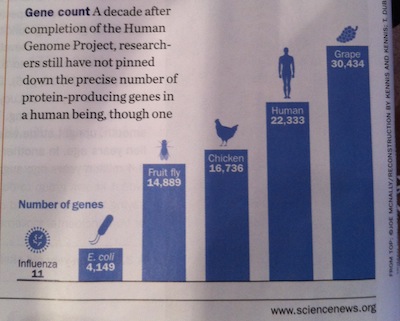
Exhibit B: Genetic Dark Matter
“A fruit fly study suggests the whole-genome approach may be the way to go.”
Exhibit C: The Genome vs The Gene
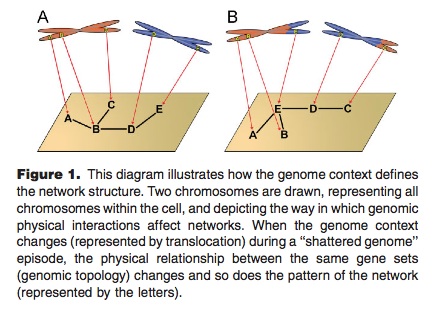
Exhibit D: The Proteome vs The Genome
“you need to look at the things that the genes are producing, and what’s happening after the genetics.”
…
The New Scientific Enlightenment
There is a massive paradigm shift occurring: beliefs about the nature of scientific inquiry that have held for hundreds of years are being questioned.
As laypeople, we see the symptoms all around us: climatology, economics, medicine, even fundamental physics; these domains (and more) have all become battlegrounds with mounting armies of Ph.D.s and Nobel Prize winners entrenching in opposing camps. Here’s what’s at stake:
. . .
Scientific Objectivity
In 1972 Kahneman and Tversky launched the study into human cognitive bias, which later won Kahneman the Nobel. Even a cursory reading of this now vast literature should make each and every logically-minded scientist very skeptical of their own work.
A few scientists do take bias seriously (c.f. Overcoming Bias and Less Wrong). Yet, nearly 40 years later, it might be fair to say that its impact on science as a whole has been limited to improving clinical trials and spawning behavioral economics.
In 2008, Farhad Manjoo poignantly illustrates …
The Process
Imagine a multiverse, infinitely infinite. There’s just infinity. Or if you prefer, nothing. There’s no space, no time, no matter, no energy. There’s no structure whatsoever, and nothing “in” any of the universes that make up the multiverse. it’s not even clear whether these individual universes are separate from one another or the same. But since our minds seem finite and we have to start somewhere, let’s imagine them as separate: an infinite collection of universes with nothing in them, no dimension, and no relationship between them.
Now lets assume there is some process for picking out universes from the multiverse. Since there’s no time in the multiverse, the process has no beginning and no end. It’s like a computer program, but it’s infinitely complex. Let’s call it The Process.
If The Process is infinitely complex and has no beginning and no end, what can we know about it? We know that it picks some universes but not others, which effectively creates an “in …
The Technium
Here are the slides from his talk. My favorites are 3, 4, 8, 10, 15, 19, 21, 23, 26, 28, 29, 35, 37, 38, 53, 66, 68.
Synthesis of Complexity Theory
As careful readers of this blog will note, I’ve been obsessed with Alex Ryan’s visualization of the way new levels of organization come into being (e.g. atoms -> molecules -> cells, etc). In an attempt to complement and extend his model, here’s a visualization of how I think of the various concepts coming together:
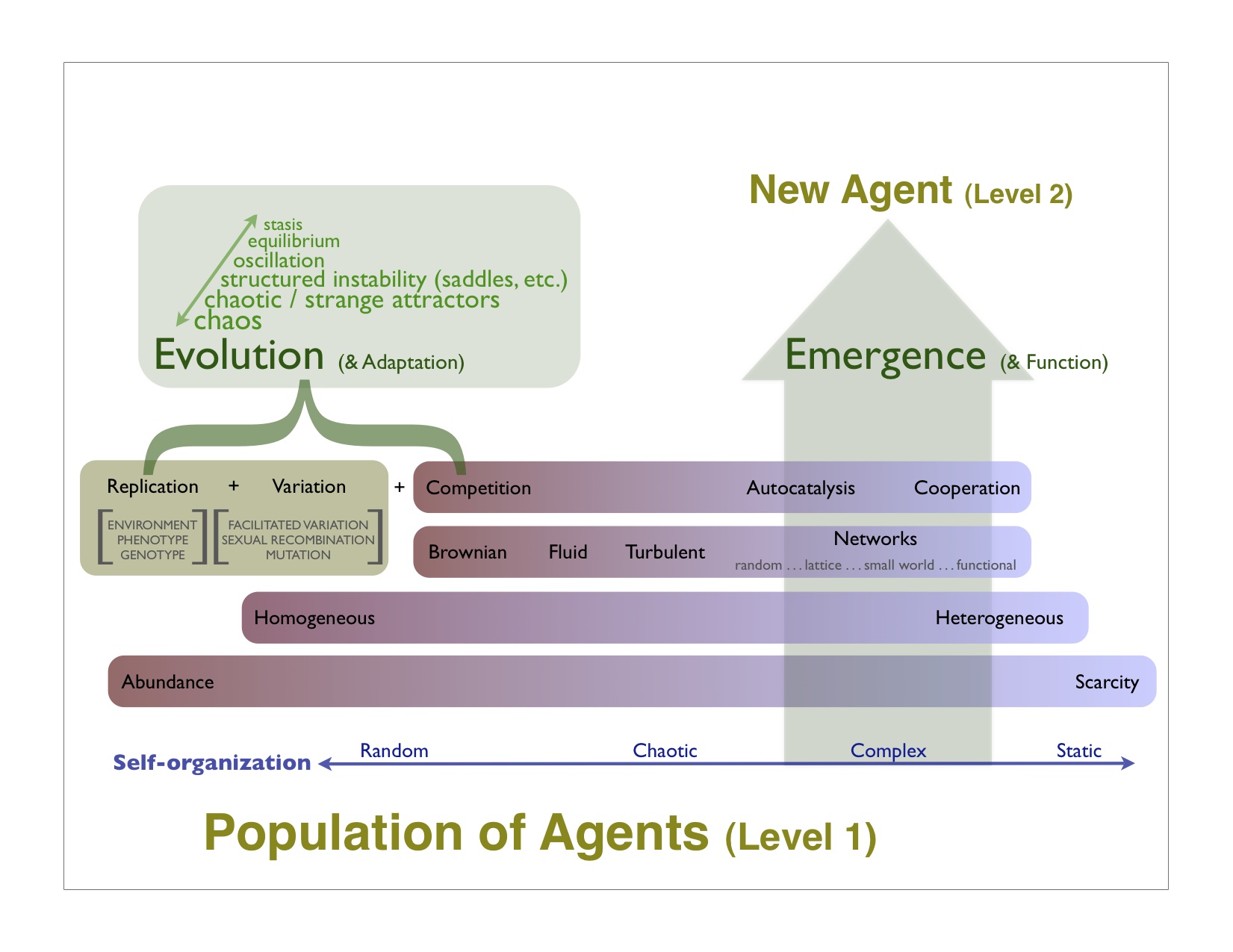
First off, I know that this may not make sense to most people. The relationships implied by proximity, color, dimension, etc are not totally accurate. The problem is, I’ve reached the limit of my personal ability to create a good visualization. So I’m throwing this out there half-baked hoping that the crowd (that’s you) will help bring this together in a more coherent way.
I’m especially interested in hearing from people who have great design skills. If you don’t, then at the least you can ask probing questions to suss out the sources of confusion, which will then feed into the redesign process.
A more detailed explication of these concepts can …
Convergence
As readers of my blog posts know, I talk a lot about evolutionary systems, the formal structure of cooperation, the role of both in emergence of new levels of complexity, and I sometimes use cellular automata to make points about all these things and the reification of useful models (here’s a summary of how they all relate). I’ve also touched on this “thing” going on with the system of life on Earth that is related to technological singularity but really is the emergence or (or convergence) of an entirely new form of intelligence/life/collective consciousness/cultural agency, above the level of human existence.
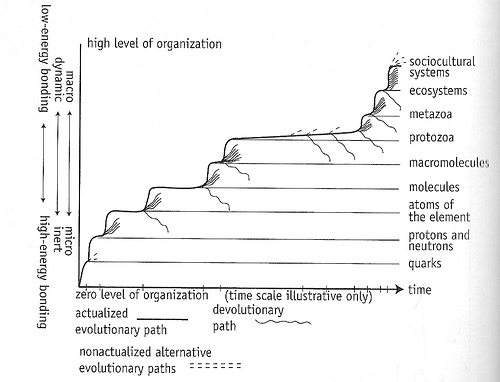
From The Chaos Point. Reproduced with permission from the author.
In a convergence of a different sort, many of these threads which all come together and interrelate in my own mind, came together in various conversations and talks within the last 15 hours. And while it’s impossible to explain this all in details, it’s really exciting to find other people who are on …
Comments on Human Cultural Transformation
This is a followup to Ben’s post on Human Cultural Transformation Triggered by Dense Populations. Too many links for this to be accepted into the comments directly…
In thinking about these questions, it helps me to remind myself of the difference between evolution and emergence. Evolution happens whenever you have a population of agents with heritable variation and differential reproduction rates. There are at least two types of emergence, both of which can create new types of agents. Various self-reinforcing mechanisms lead to stronger and more stable agency. We may not even recognize the emergence of nascent agents for what they are until said agency (or coherence) becomes strong enough. For instance, many people have a hard time wrapping their head around cultural agency of any form.
Obviously none of us on here have a problem with the concept of non-human agency, but as Alex and Ben collectively point out, cultural agents depend on human agents for their very existence. Yet …
Answer to "Guess What Species?"
Yesterday’s puzzler was to guess the species being talked about here:
One became super efficient at gobbling up its food, doing so at a rate that was about a hundred times faster than the other. The other was slower at acquiring food, but produced about three times more progeny per generation.
The answer is……
Is the Party Over?
I don’t like the Republican or Libertarian parties. But I’m also no fan of the Democratic party. In fact, I dislike all political parties and think they should be done away with. And while I’m not naive enough to think that this will happen, it makes me glad to see that the “post partisan” utopia is closer today than it was a year ago.…
The Vanguard of Science: Bonnie Bassler
The import of this talk goes way beyond the specific and stunning work that Bassler and her team have done on quorum sensing. In my mind, this is the prototype for good biological science:…
What is the Best Idea Ever?
Daniel Dennett and others have called Darwin’s theory of evolution the best idea anyone has ever had. That means that all the ideas that Socrates, Da Vinci, Newton and Einstein ever had, plus all the ideas that everyone else has ever had are also rans. It would be impossible to really justify such a claim objectively, but I will give my guess as to why it might be considered so, at least by luminaries in Western society.
My suggestion is that evolution is the first theory — in the scientific tradition — based on the principle of emergence. That is, it looks at a system from the bottom up, starting with behavior at the micro level and yielding behavior at the macro level.
Regardless of the above, what gets your vote for the best idea ever?…
Micro -> Macro -> Micro, etc.
Kevin has a few threads regarding the effect that micro behaviors have when aggregated to macro behaviors:
- Society According to Kevin
- I May Have Been Wrong About Macroeconomics
- But I Was Probably Right About Climate Models
It occurred to me as I was reading this Huffington Post article that there is a reverse-emergent dynamic that occurs when countries (often through their leaders) send signals to other countries through word and action.…
Emergence 101
[I just noticed the video links were broken in my original post, so I’m reposting this]
Apparently this PBS NOVA program aired last year, but somehow I missed it. Definitely worth watching (and looking at the examples), especially if you are mystified by all of this “emergence mumbo jumbo”:
Part 1
http://www.youtube.com/watch?v=HnO_MKHG_LoPart 2
…Superfoo
Response to Superorganism as Terminology.
I was actually about to post something about terminology, so I’m glad this came up. It’s just so difficult to choose words to describe concepts that have little precedent, without going to the extreme of overloading on the one end (e.g. “organism”) or the other extreme of being totally meaningless (e.g. “foo”). I have tried to use terms that are the closest in meaning to what I’m after but there’s no avoiding the misinterpretation. I can only hope by defining and redefining to an audience that is not quick to make snap judgments but rather considers the word usage in context, we can converge to at least a common understanding of what I am claiming. From there at least we have a shot at real communication of ideas and hopefully even agreement.…
Response to "Superorganism Considered Harmful"
This is a response to Kevin’s post responding to my post.
…Rafe makes an analogy to cells within a multicellular organism. How does this support the assertion that there will only be one superorganism and that we will need to subjugate our needs to its own? Obviously, there are many multicellular organisms. Certainly, there are many single-celled organisms that exist outside of multicelluar control today. So where is the evidence that there will be only one and that people won’t be able to opt out in a meaningful sense?
The Emergent Universe
In a previous post I asked what you thought this was:
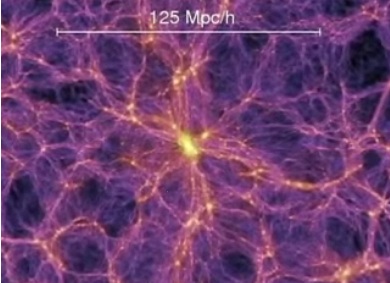
Here is the same system at different resolutions (lowest to highest):…
The Conflict Between Complex Systems and Reductionism
The following is a recent paper by Henry Heng published in JAMA. I’ve linked concepts mentioned in the paper to corresponding explications from this blog.
JAMA. 2008;300(13):1580-1581.
The Conflict Between Complex Systems and Reductionism
Henry H. Q. Heng, PhD
Author Affiliations: Center for Molecular Medicine and Genetics, Wayne State University School of Medicine, Detroit, Michigan.
Descartes’ reductionist principle has had a profound influence on medicine. Similar to repairing a clock in which each broken part is fixed in order, investigators have attempted to discover causal relationships among key components of an individual and to treat those components accordingly. …
Go Forth and Reify, part II
In this video talk by Richard Darkins he gives some good food for thought on reification when he talks about Steve Grand’s views on things like whirlpools, electromagnetic fluctuations and walking sand dunes. The most powerful example is this one (quoting Grand):
…Think of an experience from your childhood. Something you remember clearly, something you can see, feel, maybe even smell, as if you were really there. After all, you really were there at the time, weren’t you? How else would you remember it? But here is the bombshell: you weren’t there. Not a single atom that is in your body today was there when that took place…Matter flows from place to place and momentarily comes together to be you. Whatever you are, therefore, you are not the stuff of which you are made. If that doesn’t make your hair stand up on the back of your neck, read it again until it does, because it is important.
Go Forth and Reify
reify |ˈrēəˌfī|
verb ( -fies, -fied) [ trans. ] formal
make (something abstract) more concrete or real
Imagine if an alien landed on Earth to study modern society and you were assigned the task of being its local guide. You get to the subject of money and the alien is perplexed. What is money? Is it paper currency? Clearly not, since you can exchange that paper for other forms of currency, such as coins, foreign bank notes, electronic funds, treasury bills, and all sorts of derivatives, assets (both tangible and intangible, liquid and illiquid), services, promises, and so on. After hearing all of the various aspects of money, the alien tells you that money doesn’t really exist.…
Complex Systems Concept Summary
I figured it was time for a reset and so the following is a summary of much of the foundational posting that I’ve done on this blog so far. As always, a work in progress, subject to refinement and learning……
Complex Links: TED
I attended the TED Conference this year for the first time. It was a transformative experience, one that I hope everyone can have in some form or another before too long. One way to simulate being there is watch as many of these incredible talks from past TED conferences as you can in a short period of time. If you are inspired, check out the TED Prize and how you can be a part of a growing global meta-movement for positive change in the world.
I will be blogging about things that piqued my interest at TED, but below are some cool links that I came away with:…
Response to "Thoughts on Ants, Altruism and the Future of Humanity"
[ This is an edited version of a blog comment on Brandon Kein’s Wired Science post here ]
The question of whether we will “break through” to a superorganism or collapse through any number of spiraling cascades or catastrophic events is the subject of Ervin Laszlo’s book, The Chaos Point, which I highly recommend. In it, he gives a sweeping view of the complex evolutionary dynamic (focusing on human society), and makes a solid argument that we are at an inflection point in history right now, similar to the “saltation” that begat multicellularity.…
Blog Comment, Cooperation, Culture, Emergence, Levels, Singularity, Society Blog Comment, Cooperation, Culture, Emergence, Levels, Singularity, Society, 2