Evolution
End of The Gene
Exhibit A: Reductio Ad Absurdum
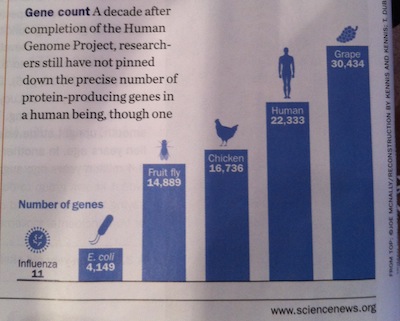
Exhibit B: Genetic Dark Matter
“A fruit fly study suggests the whole-genome approach may be the way to go.”
Exhibit C: The Genome vs The Gene
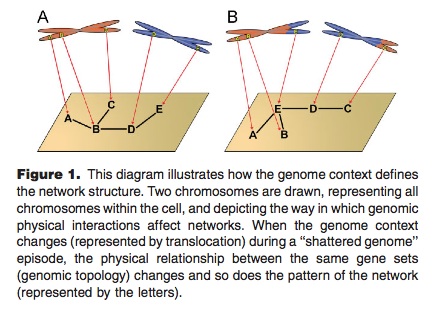
Exhibit D: The Proteome vs The Genome
“you need to look at the things that the genes are producing, and what’s happening after the genetics.”
…
Biological Immortality
There’s a scientific paradox in the world of nutrition about what the optimal diet is. A new theory may resolve the paradox. Oh, and help you live forever too.
The majority consensus is the “post-agricultural revolution diet” is best, which says that a majority of your intake should be vegetables and fruits, and that you should severely limit your animal product intake, especially red meats. Some proponents (like T. Colin Cambell of China Study fame) go as far as claiming that a strictly vegan diet is best.
The other camp argues for the “paleo” or “caveman” diet, which says we need to eat what our paleolithic ancestors ate: lots of foods high in animal fat and animal protein, and avoid industrialized grains altogether (some fermented natural grains are fine). Fermented foods in general are encouraged, honoring the fact that before preservation, refrigeration and pasteurization we evolved a symbiosis with bacterias that are critical for our digestion and processing of nutrients.
Both sides agree that processed …
Why Falsifiability is Insufficient for Scientific Reasoning
In my post about The Process it turns out that I stepped on a pedagogical minefield when using describing the Anthropic Principle (AP). Two preeminent physicists had a very public argument a while ago in which one called the AP unscientific because it’s unfalsifiable. I will return to that in a moment since it’s the crux of what’s wrong with Science right now, but I need to get the terminology issue out of the way first.
Lee Smolin claims that AP is bad and favors a Cosmological Natural Selection view instead (on grounds of falsifiability). I believe this is a false dichotomy and that they are really one and the same. Here’s why:
- Normally natural selection requires some form of “replication” or it’s not actually natural selection. But replication is not needed if you start with an infinity of heterogeneous universes. In other words replication is simulated via the anthropic lens over the life-supporting subset of all possible universes.
- Replication is a red herring anyway
Synthesis of Complexity Theory
As careful readers of this blog will note, I’ve been obsessed with Alex Ryan’s visualization of the way new levels of organization come into being (e.g. atoms -> molecules -> cells, etc). In an attempt to complement and extend his model, here’s a visualization of how I think of the various concepts coming together:
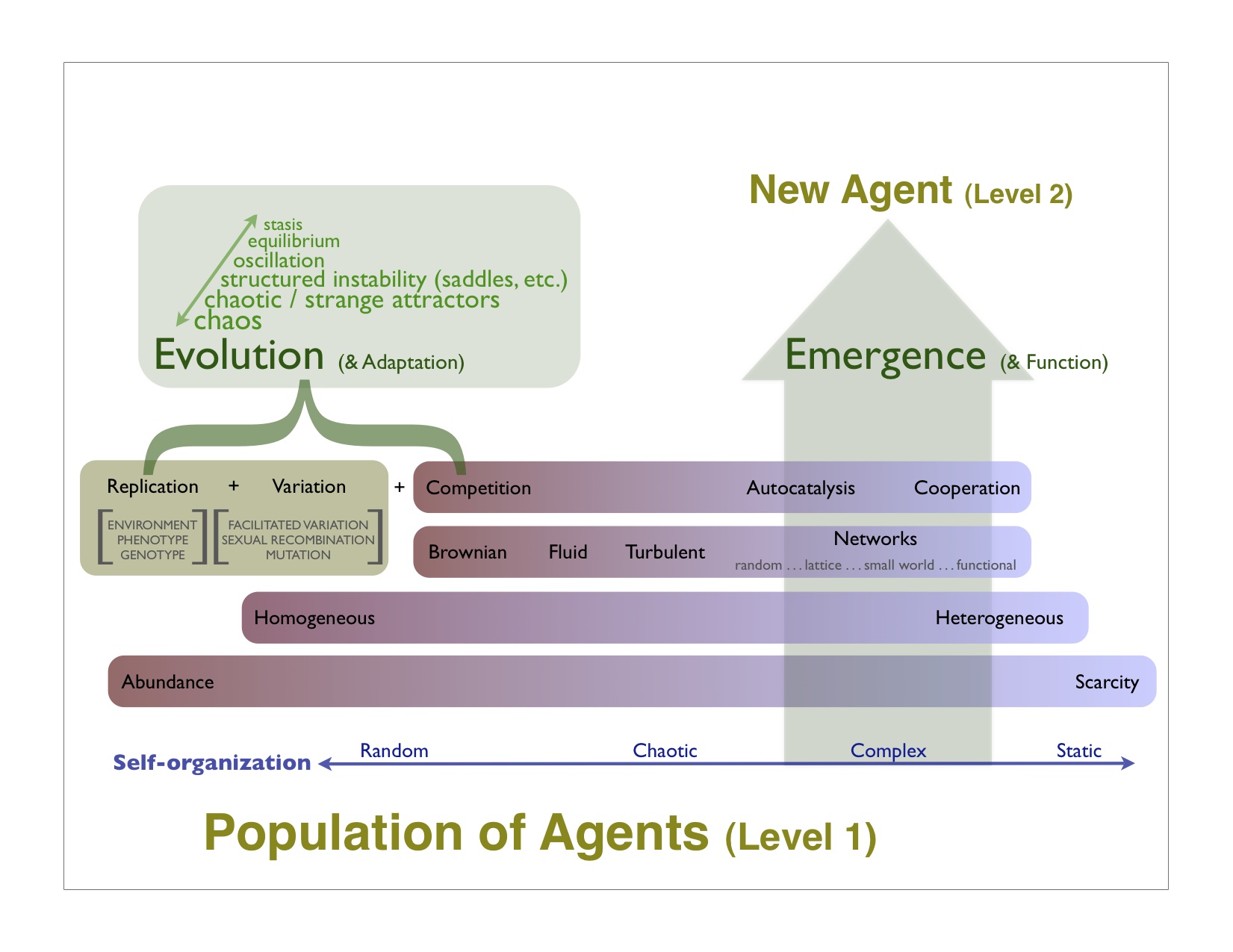
First off, I know that this may not make sense to most people. The relationships implied by proximity, color, dimension, etc are not totally accurate. The problem is, I’ve reached the limit of my personal ability to create a good visualization. So I’m throwing this out there half-baked hoping that the crowd (that’s you) will help bring this together in a more coherent way.
I’m especially interested in hearing from people who have great design skills. If you don’t, then at the least you can ask probing questions to suss out the sources of confusion, which will then feed into the redesign process.
A more detailed explication of these concepts can …
Approaching a Cure for Cancer
James Watson, co-discoverer of DNA’s double-helix structure recently called for a back to basics approach in dealing with cancer. In previous post threads I’ve discussed cancer’s complexity and in particular the confounding and scary implications of somatic evolution, which underscores some of the reasons we are not winning the “war on cancer.” Here I will discuss some cutting edge approaches to treating and preventing cancer and how they might pan out in light of the complexities of the disease. The categories below are not mutually exclusive, and the examples cited are nowhere near exhaustive, but this should give you some food for thought. If you have ideas, questions or know of approaches that should be highlighted, please comment.
Target & Kill Approaches
Biris and Zharov are making some exciting progress in using nanotubes to tag and then track cancer cells inside the body as they move around. They propose to kill the cancer cells by heating up the nanotubes using lasers, while others are …
Convergence
As readers of my blog posts know, I talk a lot about evolutionary systems, the formal structure of cooperation, the role of both in emergence of new levels of complexity, and I sometimes use cellular automata to make points about all these things and the reification of useful models (here’s a summary of how they all relate). I’ve also touched on this “thing” going on with the system of life on Earth that is related to technological singularity but really is the emergence or (or convergence) of an entirely new form of intelligence/life/collective consciousness/cultural agency, above the level of human existence.
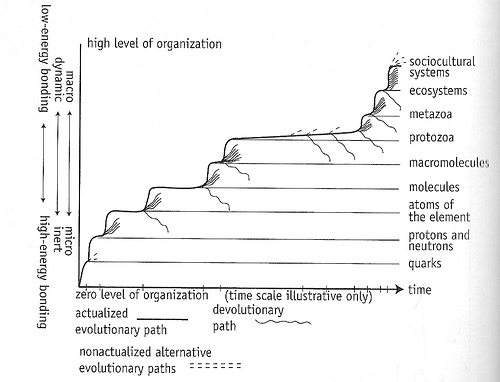
From The Chaos Point. Reproduced with permission from the author.
In a convergence of a different sort, many of these threads which all come together and interrelate in my own mind, came together in various conversations and talks within the last 15 hours. And while it’s impossible to explain this all in details, it’s really exciting to find other people who are on …
Comments on Human Cultural Transformation
This is a followup to Ben’s post on Human Cultural Transformation Triggered by Dense Populations. Too many links for this to be accepted into the comments directly…
In thinking about these questions, it helps me to remind myself of the difference between evolution and emergence. Evolution happens whenever you have a population of agents with heritable variation and differential reproduction rates. There are at least two types of emergence, both of which can create new types of agents. Various self-reinforcing mechanisms lead to stronger and more stable agency. We may not even recognize the emergence of nascent agents for what they are until said agency (or coherence) becomes strong enough. For instance, many people have a hard time wrapping their head around cultural agency of any form.
Obviously none of us on here have a problem with the concept of non-human agency, but as Alex and Ben collectively point out, cultural agents depend on human agents for their very existence. Yet …
Cancer as a Complex Adaptive System
Heng, et al recently published a review paper that brings together and touches on many different aspects of cancer complexity. I thought this an opportunity to selectively quote the paper and organize the quotes loosely around various complex systems concepts they relate to. I’m curious whether this makes sense to readers of this blog, or whether there’s too much unexplained jargon and too many large conceptual leaps. Please ask questions or make comments freely below.
One preface I think will help is to understand that genome, karyotype and chromosome refer roughly to the same thing. Here are several schematics that I will present without explanation that together illustrate how genes relate to genome/karyotype/chromosome structure, and how that in turn relates to the so-called genetic network (loosely equivalent to the “proteome”). Of course “gene” is an outdated and inaccurate concept, so don’t get too hung up looking for genes here, just understand that they are sub-structural elements of the genome.
From MSU website
Homo Evolutis
In Juan Enriquez’ TED talk earlier this year, he made the point that humans have entered a new phase of evolution, one that has not been seen on before modern humans and their technology. This, of course, is one of the main theses of Ray Kurzweil’s book, The Singularity is Near, and the main justification for the creation of The Singularity Institute (plus related Singularity Summit), and now just recently, Singularity University.
Lest you think the concept of Homo Evolutis — a species that can control its own evolutionary path by radically extend healthy human lifespan and ultimately merging with its technology — is a fringe concept share by sci-fi dreamers who don’t have a handle on reality, check out the list of people in charge of Singularity University (link above), the Board members of the Lifeboat Foundation, and throw in Stephen Hawking for good measure, who says, “Humans Have Entered a New Phase of Evolution“. These people not only …
Foldit
Has anyone played Foldit, the protein-folding game that is designed to advance the science? This Wired article makes it sound like Ender’s Game meets biochemistry! Sounds like the Poehlman kid is the protein-folding equivalent of Stephen Wiltshire. I love the crowdsourcing, the meta-evolutionary algorithm of it (to find the savants), and the implications for science.…
Answer to "Guess What Species?"
Yesterday’s puzzler was to guess the species being talked about here:
One became super efficient at gobbling up its food, doing so at a rate that was about a hundred times faster than the other. The other was slower at acquiring food, but produced about three times more progeny per generation.
The answer is……
Guess What Species?
Without doing a text search (that would be cheating), guess what species is being referred to in this quote about the evolution of competing strategies:
One became super efficient at gobbling up its food, doing so at a rate that was about a hundred times faster than the other. The other was slower at acquiring food, but produced about three times more progeny per generation.
Answer in tomorrow’s post.…
Sleep as the Default State
Just read an interesting essay* which changed my thinking about the role of sleep. While nobody can claim to understand exactly why sleep is necessary for mammals, most of the explanations focus on some positive, regenerative benefits that we can’t do without (e.g. maintaining the neuronal circuitry). Martin Kinsbourne puts forth another benefit, which I’d never thought of:…
Twitter vs. Psychoanalysis
In this Times Online article, two psychologists and an author weigh in with their view of Twitter users as narcissistic and infantile:
…The clinical psychologist Oliver James has his reservations. “Twittering stems from a lack of identity. It’s a constant update of who you are, what you are, where you are. Nobody would Twitter if they had a strong sense of identity.”
“We are the most narcissistic age ever,” agrees Dr David Lewis, a cognitive neuropsychologist and director of research based at the University of Sussex. “Using Twitter suggests a level of insecurity whereby, unless people recognise you, you cease to exist. It may stave off insecurity in the short term, but it won’t cure it.”
For Alain de Botton, author of Status Anxiety and the forthcoming The Pleasures and Sorrows of Work, Twitter represents “a way of making sure you are permanently connected to somebody and somebody is permanently connected to you, proving that you are alive. It’s like when a parent goes
What is the Best Idea Ever?
Daniel Dennett and others have called Darwin’s theory of evolution the best idea anyone has ever had. That means that all the ideas that Socrates, Da Vinci, Newton and Einstein ever had, plus all the ideas that everyone else has ever had are also rans. It would be impossible to really justify such a claim objectively, but I will give my guess as to why it might be considered so, at least by luminaries in Western society.
My suggestion is that evolution is the first theory — in the scientific tradition — based on the principle of emergence. That is, it looks at a system from the bottom up, starting with behavior at the micro level and yielding behavior at the macro level.
Regardless of the above, what gets your vote for the best idea ever?…
Cancer as Evolution — 2008 Summary
Click here to read part 4 in this series.
As 2008 closes, it appears that momentum is picking up for the somatic evolution view of cancer. Here are three recently published papers of note:
- The Evolution of Cancer (Goymer, et al, Aug 2008, Nature)
- Cancer Research Meets Evolutionary Biology (Pepper, et al, in press, 2008 Evolutionary Applications; Santa Fe Institute working paper)
- Genome Based Cell Population Heterogeneity Promotes Tumorigenicity: The Evolutionary Mechanism of Cancer (Ye, et al, Dec 2008, Journal of Cellular Physiology)
Best Talk of Pop!Tech '08
The reason I like this talk so much (besides that it’s well-presented) is that it introduces us to the idea of invisible etiology. Such a powerful concept, one that I feel has the power to help us solve so many mysteries, once we take it seriously.
Something that I’ve been thinking about lately: does homelessness have an invisible etiology (or etiologies), and if so, what is it?…
Cancer as Evolution, part 4
For those who missed the first three parts:
Any underlying theme of this thread is how reliance on reductionism causes us to miss the key invisible etiologies that are necessary to make progress on understanding, treating, detecting and preventing cancer.
In the first three parts of this series, I pointed out how the invisible etiology of somatic evolution has great explanatory and predictive power for oncology. A new paper by some researchers on the vanguard of complex systems thinking shows how adding a complementary ecological model leads us to the promising approach of ecological therapy.
A Nature Review article published a couple of years ago summarizes the case for cancer as an evolutionary and ecological process
hat tip: David Basanta…
Group Selection Meme on the Rise
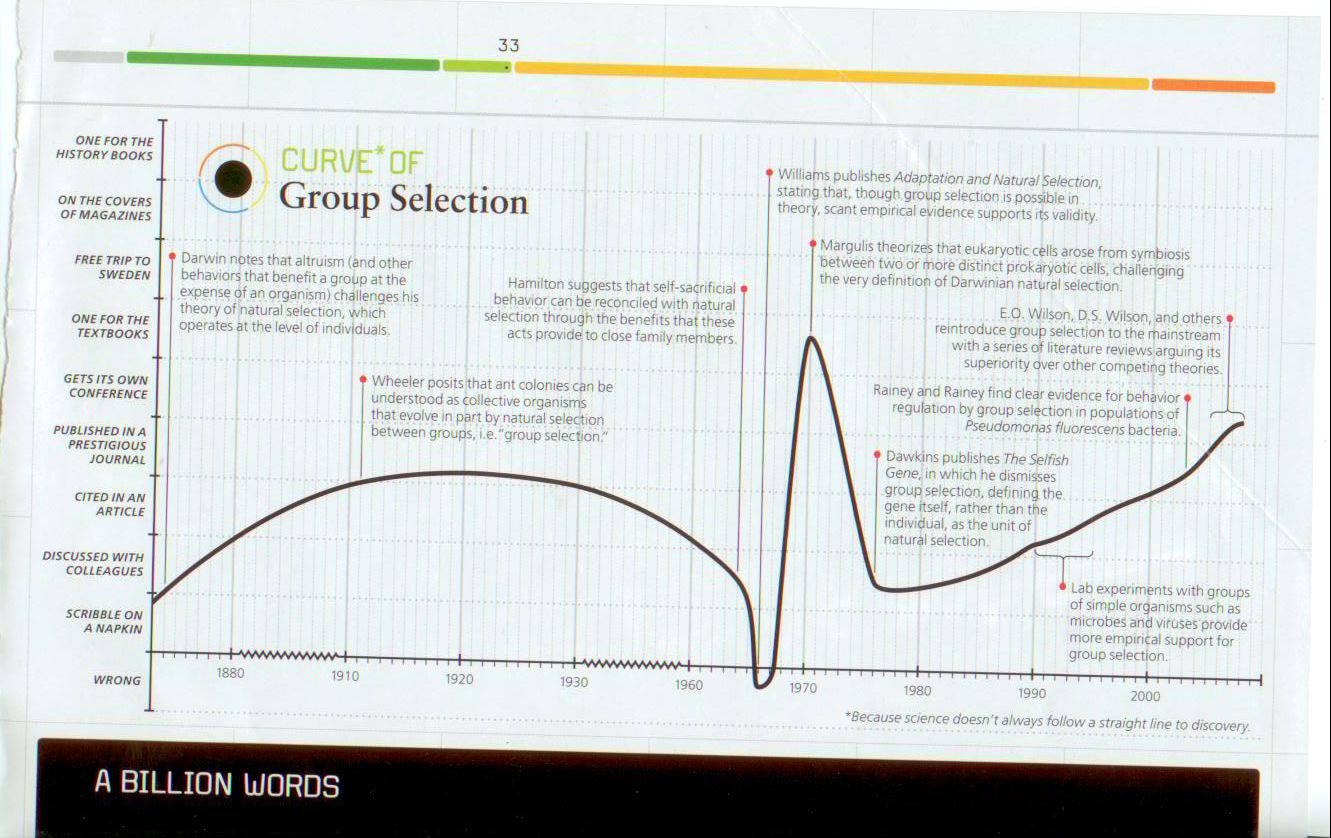
This is from a recent Seed Magazine article. Click on the image to enlarge it.…
The Conflict Between Complex Systems and Reductionism
The following is a recent paper by Henry Heng published in JAMA. I’ve linked concepts mentioned in the paper to corresponding explications from this blog.
JAMA. 2008;300(13):1580-1581.
The Conflict Between Complex Systems and Reductionism
Henry H. Q. Heng, PhD
Author Affiliations: Center for Molecular Medicine and Genetics, Wayne State University School of Medicine, Detroit, Michigan.
Descartes’ reductionist principle has had a profound influence on medicine. Similar to repairing a clock in which each broken part is fixed in order, investigators have attempted to discover causal relationships among key components of an individual and to treat those components accordingly. …
Autocatalytic Systems
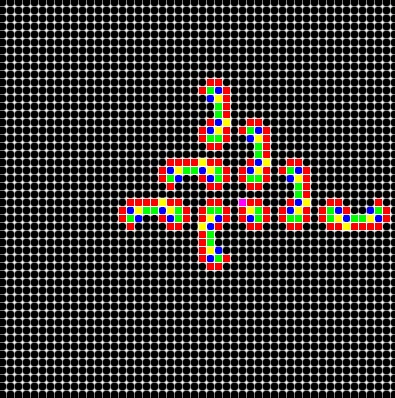
The above is a self-replicating dynamic structure from a class of systems called cellular automata (click here to run the simulation). Below is a self-replicating dynamic structure from a class of systems called “life”:…
Cancer as Evolution, part 3
Kevin points out that perhaps I am giving chemotherapy short shrift and not looking at the bigger picture. I would counter that you can’t really make the latency analogy with human life because we are all born terminal. “Mean survival time” is a squirrely measure at best because how do you know if someone died (a) because of the cancer, (b) because of the chemo, or (c) because of some other factor (in which the cancer or chemo or both) could be confounding?
If you buy the somatic evolution (SE) argument then there are all sorts of consequences which contraindicate chemo in most cases. …
Cancer as Evolution, part 2
When I posted part 1, I didn’t realize that Scientific American would be coming out with an entire special issue devoted to cancer in the same month, including an article by Carl Zimmer entitled “Evolved for Cancer?“.
I had hoped that the article would be about the somatic evolution of cancer, and while it touches on this aspect briefly and tangentially, it mostly talks about the evolution of defenses against cancer within the human population as a whole. There is a critical distinction here: somatic evolution occurs on the cells within a single body in the course of a single human lifetime,* while human evolution happens in a population of many humans over millions of years.**…
Cancer as Evolution
For anyone interested in learning about the complexity of cancer, I’d like to invite you to check out a forum I started a while ago (but only recently made public) called Cancer Complexity.
One of the main themes (but not the only one) in Cancer Complexity is the notion that cancer is an evolutionary process (as in Darwinian evolution), except that instead of populations of individual animals, the population of interest is the set of cells in the body of a single animal.…